
Choosing the Right Underlayment for Your Subfloor Type
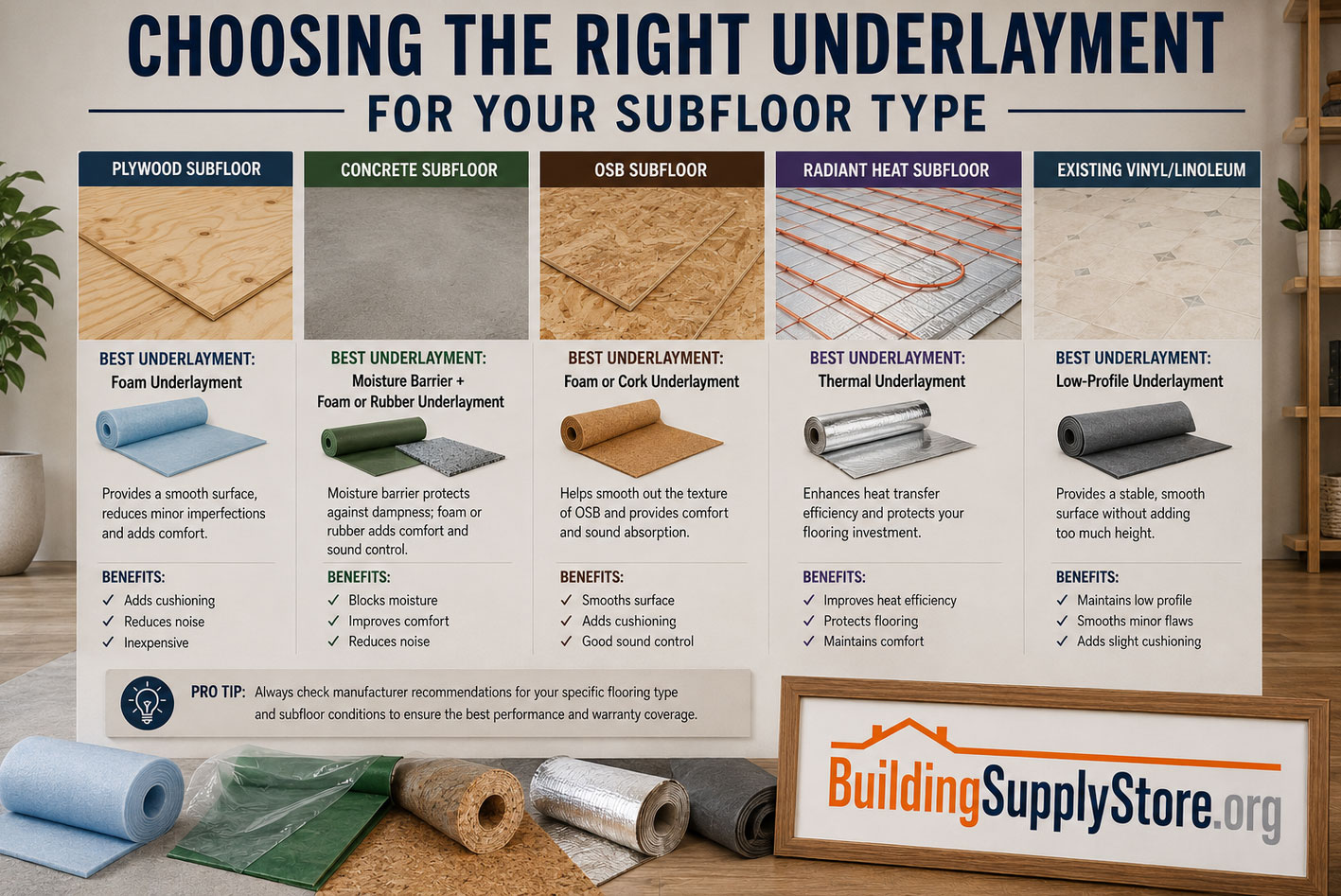
Most flooring failures don't start with the flooring. They start a quarter-inch below it, in a layer most homeowners can't name and most contractors rush through on a Friday afternoon. Underlayment is the unglamorous middle child of a flooring project — wedged between the structural subfloor and the finish material everyone actually cares about — and it's also the single biggest predictor of whether that gorgeous herringbone oak or that budget-friendly laminate is still flat, quiet, and crack-free in five years.
The right underlayment isn't a universal product. It's a decision that has to answer to three separate masters at once: what your subfloor is made of, what moisture conditions exist beneath it, and what flooring material is going on top. Get the pairing wrong and you'll hear it — literally, in the form of creaks, hollow footsteps through a shared wall, or the telltale crackle of laminate flexing over an uneven slab. Get it right, and the underlayment disappears entirely, doing its job in total silence for decades.
This guide walks through that decision the way a flooring inspector would: subfloor first, moisture second, flooring material third.
What Underlayment Actually Does (and Why Skipping It Is a Gamble)
Underlayment earns its place in an assembly by solving problems that flooring alone cannot solve. A thin foam or cork layer absorbs the small imperfections in a subfloor — the slight cupping of plywood, the faint waviness of a poured slab — so that a rigid laminate plank or luxury vinyl tile doesn't rock, click, or telegraph every seam through the surface. It provides acoustic dampening, which matters enormously in condominiums and apartments where a building's HOA or local building code may legally require a minimum Impact Insulation Class (IIC) rating before hard flooring is even permitted above another unit. It creates a moisture buffer between concrete, which behaves like a slow-drying sponge for years after it's poured, and moisture-sensitive materials like hardwood or laminate core. And in radiant-heat installations, the underlayment either helps or hinders heat transfer, depending on its thermal resistance.
Skip it, or mismatch it, and you inherit someone else's problem in eighteen months: buckled laminate, hollow-sounding vinyl, tile that cracks along grout lines, or a hardwood floor that cups because nobody checked what was happening beneath the surface before installation day.
Start With What's Actually Beneath Your Feet
Before comparing underlayment products, identify the subfloor. This single step eliminates more wrong choices than any amount of underlayment research.
Concrete Slabs (On-Grade and Below-Grade)
Concrete is porous, alkaline, and — even years after the pour — still capable of releasing moisture vapor upward. Basement slabs and on-grade slabs in humid climates are the most common offenders. Before selecting underlayment, the moisture content needs to be measured using either the calcium chloride test (ASTM F1869) or an in-situ relative humidity probe (ASTM F2170), the two industry-standard methods most flooring manufacturers reference in their warranty documentation. A slab reading above roughly 3 lbs per 1,000 square feet per 24 hours on the calcium chloride test, or above 75–80% relative humidity depending on the flooring manufacturer's threshold, generally requires a vapor-retarding underlayment or a separate liquid or sheet membrane before anything else goes down.
Concrete also needs a leveling conversation. Slabs poured by different crews, or slabs that have settled unevenly over decades, often carry variances that exceed what flooring manufacturers allow — typically 3/16 inch over a 10-foot radius for rigid materials like tile or engineered wood. A self-leveling compound may need to happen before underlayment is even relevant.
Plywood and OSB Subfloors
The most common subfloor in wood-framed homes, plywood and oriented strand board (OSB) are dimensionally stable but not moisture-proof, and they expand and contract seasonally with humidity. These subfloors generally accept the widest range of underlayment products, but fastening pattern matters — squeaky spots usually mean loose fasteners, not a defective underlayment, and no foam pad will fix a structural squeak. Before installing anything, sweep for protruding nail heads, sand down high spots at seams, and confirm the deck itself meets flatness tolerances.
Existing Tile, Vinyl, or Other Hard Flooring
Removing old flooring isn't always required, and leaving it in place changes the underlayment equation. Existing ceramic tile, for instance, is an excellent substrate for new resilient flooring because it's flat, rigid, and stable — but it's a poor candidate for nail-down hardwood without an intermediate plywood layer. Old vinyl sheet flooring containing asbestos is a separate and serious issue; pre-1980s vinyl should be tested before sanding, cutting, or removal, not simply covered over.
Older Plank or Board Subfloors
Homes built before roughly 1970 often have diagonal or straight board subfloors rather than plywood sheets. These substrates flex more, have larger gaps between boards, and are more prone to movement. They typically need a plywood or luan overlay — not just a thin foam underlayment — before receiving tile, engineered wood, or vinyl plank, because the gaps between boards will telegraph through thinner materials over time.
The Underlayment Lineup: Materials and What They're Actually For
Foam and Film
Thin polyethylene or polypropylene foam, often 2–3mm thick, is the default underlayment for floating laminate and some engineered wood installations over plywood or OSB. It's inexpensive, easy to install, and provides minor sound dampening and minor leveling — but it does almost nothing against significant moisture and shouldn't be relied on as a vapor barrier unless the product specifically states it includes a film layer rated for that purpose.
Cork
Cork underlayment offers superior sound absorption compared to standard foam, along with a small amount of thermal insulation, making it popular for multifamily buildings with strict IIC requirements and for homeowners installing floating floors over concrete. It compresses less over time than foam, which matters for long-term stability under engineered hardwood.
Rubber
Rubber underlayment is the heavyweight option for acoustic performance, commonly specified in condo buildings with aggressive sound transmission requirements. It's denser, more expensive, and typically reserved for situations where a building's engineering requirements — not just personal preference — dictate the choice.
Felt and Recycled Fiber
Felt underlayment, often made from recycled fiber, is a traditional choice under solid hardwood and engineered wood, particularly in nail-down installations. It provides a small cushioning effect and modest sound dampening without adding excessive height to the floor assembly.
Cement Backer Board
For tile installations, cement backer board (or fiber-cement board) remains the traditional rigid underlayment, providing a stable, water-resistant surface for thin-set mortar to bond to. It's heavier and more labor-intensive to install than membrane systems, requiring screws driven at specific intervals and taped, mudded seams.
Uncoupling and Waterproofing Membranes
Modern tile installations increasingly use uncoupling membranes — thin, dimpled sheet products that decouple the tile layer from minor subfloor movement, preventing cracked grout lines and tile fractures. These membranes also handle waterproofing in wet areas like showers, replacing the older backer-board-plus-topical-sealant approach. They're specified extensively in the tile installation handbook published by the Tile Council of North America.
Plywood and Luan Overlays
When a subfloor is too flexible, too gapped, or too uneven for direct installation, a 1/4-inch plywood or luan overlay creates a new, stable surface. This is common over old plank subfloors before hardwood, tile, or sheet vinyl and is functionally a subfloor upgrade disguised as an underlayment step.
Matching Underlayment to the Flooring Going on Top
Laminate
Laminate almost always floats, meaning it isn't fastened to the subfloor, which puts real pressure on the underlayment to manage minor unevenness and sound. Foam or cork underlayment is standard over plywood or OSB; over concrete, a combination product with an integrated vapor barrier is close to mandatory, since laminate's fiberboard core swells permanently and irreversibly when exposed to moisture.
Engineered Hardwood
Engineered hardwood can float, glue down, or nail down depending on the product and the subfloor. Floating installations use foam or cork similar to laminate. Glue-down installations over concrete typically require a moisture-mitigating adhesive or membrane rather than a separate underlayment sheet. Nail-down installations over plywood often use rosin paper or felt, mainly to reduce squeaks and minor moisture transfer between the subfloor and the wood.
Solid Hardwood
Solid hardwood is more moisture-reactive than engineered wood and is rarely installed directly over concrete without a raised plywood subfloor system first. Over plywood, a felt or rosin paper layer beneath a nail-down installation remains the traditional and still-effective standard.
Luxury Vinyl Plank and Tile (LVP/LVT)
Many premium LVP products now include attached underlayment (often called "pre-attached pad") specifically engineered for sound and minor leveling, which means adding a separate underlayment can sometimes void the manufacturer's warranty or exceed the flatness tolerance the click-lock system was designed for. Always check the manufacturer's specific installation instructions before adding a layer — this is one of the more common and avoidable mistakes in the industry right now.
Ceramic and Porcelain Tile
Tile is unforgiving of subfloor movement, which is why cement backer board or an uncoupling membrane isn't optional — it's structural to the installation's success. Skipping this step, even over a seemingly solid plywood subfloor, is the leading cause of cracked grout and fractured tiles within the first two years.
Carpet
Carpet padding is technically an underlayment in its own right, and the density and thickness matter more than most homeowners realize. Over-cushioned padding under carpet actually shortens the carpet's lifespan by allowing excessive flex at the backing, while too-thin padding accelerates wear. Most manufacturers specify a maximum padding thickness (often around 7/16 to 1/2 inch) and a minimum density for warranty compliance.
Moisture Is the Silent Underlayment Killer
More flooring failures trace back to unmanaged moisture than any other single cause, and underlayment is the last line of defense before that moisture reaches a vulnerable finish material. Concrete slabs are the primary risk zone, but even plywood subfloors near bathrooms, kitchens, and exterior walls can carry enough ambient humidity to matter.
The practical fix is testing before installing, not guessing. ASTM International, the standards body headquartered at 100 Barr Harbor Drive, West Conshohocken, PA 19428, publishes the calcium chloride and relative humidity testing standards referenced throughout the flooring industry, and its full standards library is publicly searchable for anyone who wants to see the exact testing protocol a contractor should be following. Flooring manufacturers set their own acceptable moisture thresholds, and those numbers should be checked against the actual subfloor reading — not assumed — before underlayment selection happens.
Sound Matters More Than Most Homeowners Expect
In single-family homes, acoustic performance is a comfort preference. In condominiums, townhomes, and multi-unit buildings, it's frequently a legal requirement written into the building's governing documents, referencing a minimum Impact Insulation Class (IIC) and Sound Transmission Class (STC) rating that hard flooring must meet before installation is approved. Cork and rubber underlayments generally perform best here, and many manufacturers publish third-party lab test results showing the exact IIC rating achieved when their underlayment is paired with a specific flooring product over a specific subfloor — worth requesting before purchase if a building association is involved.
Radiant Heat Changes the Whole Equation
Homes with radiant floor heating — hydronic tubing or electric mats embedded in or beneath the subfloor — need underlayment selected partly on thermal resistance (R-value), not just cushioning or sound performance. Thick foam or cork underlayment can trap heat and reduce system efficiency, or in some cases trigger flooring manufacturers to void warranties over engineered wood installed above radiant systems. Manufacturers of radiant systems typically publish a maximum combined R-value for the flooring-and-underlayment assembly, and that number should be checked against the underlayment's spec sheet before purchase.
A Quick Room-by-Room Reference
| Space | Common Subfloor | Typical Flooring | Underlayment Priority |
|---|---|---|---|
| Basement | Concrete slab | LVP, engineered wood | Vapor barrier first |
| Kitchen | Plywood/concrete | Tile, LVP | Moisture resistance |
| Bathroom | Plywood/concrete | Tile | Waterproof membrane |
| Condo living room | Concrete/plywood | Engineered wood, laminate | Acoustic (IIC/STC) rating |
| Upstairs bedroom | Plywood/OSB | Carpet, hardwood | Sound dampening, minor leveling |
| Sunroom over slab | Concrete, radiant heat | LVP, tile | Thermal-rated underlayment |
Mistakes That Undercut Even a Good Underlayment Choice
The most expensive mistakes in this category rarely come from buying the wrong underlayment brand — they come from skipping the diagnostic step that should precede the purchase. Installing over a concrete slab without testing moisture, adding a separate underlayment beneath vinyl plank that already has attached padding, using felt paper as if it were a moisture barrier, or assuming an old plank subfloor is flat enough for tile without a leveling layer are the repeat offenders that show up in warranty claims and inspection reports year after year.
Another quieter mistake is underlayment thickness creep — stacking a thicker pad than a manufacturer specifies in the belief that "more cushion is better." Click-lock flooring systems are engineered around a specific compression tolerance, and exceeding it can cause seams to separate or locking mechanisms to fail under normal foot traffic.
Where to Verify Before You Buy
Manufacturer specification sheets are the first stop, but industry associations publish freely available installation guidelines that are worth cross-referencing, especially when a warranty is on the line:
- The National Wood Flooring Association, headquartered at 14 Research Park Drive, St. Charles, MO 63304, publishes installation guidelines covering solid and engineered wood over a range of subfloor types.
- The Tile Council of North America, based at 100 Clemson Research Blvd, Anderson, SC 29625, produces the annually updated Handbook for Ceramic, Glass, and Stone Tile Installation — the closest thing the tile industry has to a universal reference for backer board and membrane selection.
- ASTM International, at 100 Barr Harbor Drive, West Conshohocken, PA 19428, maintains the moisture-testing standards referenced by virtually every flooring manufacturer's warranty documentation.
- The National Association of Home Builders, headquartered at the National Housing Center, 1201 15th Street NW, Washington, DC 20005, offers broader construction and remodeling standards that touch on subfloor preparation and moisture management in new construction.
The Bottom Line
Underlayment selection isn't a single decision — it's the intersection of three: what the subfloor is, how much moisture it's carrying, and what flooring material is going on top. Skip the diagnostic step and even an expensive, well-reviewed underlayment can fail within a couple of years. Take it seriously, test what needs testing, and match the product to the actual conditions rather than a generic recommendation, and the underlayment does exactly what it's supposed to do: disappear, permanently, underneath a floor that stays flat, quiet, and intact for the long haul.