
Ladder Weight Ratings Explained: A Field Guide to Duty Ratings I Through IAA
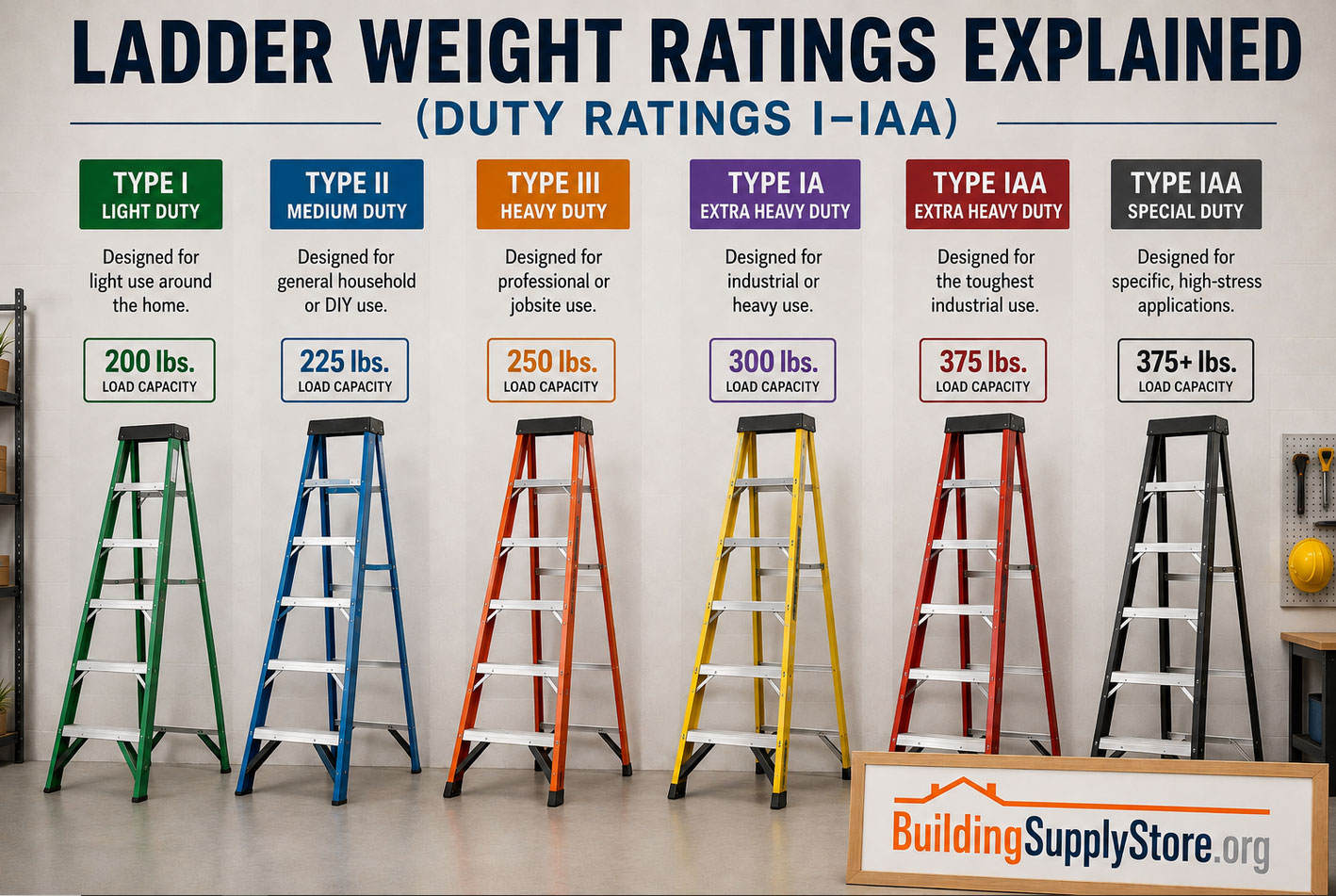
Most people buy a ladder the way they buy a garden hose — by length, by price, and by whatever's stacked closest to the store exit. The duty rating sticker, if it gets noticed at all, reads like fine print on a rental car agreement: technically important, practically ignored. That's a mistake with real consequences. A ladder's duty rating isn't a marketing footnote. It's an engineering promise about how much total weight the rails, rungs, and locking hardware were tested to hold before something gives way underneath you.
This guide walks through what the Type I through Type IAA classifications actually mean, where the numbers came from, how to calculate the load a ladder needs to carry for your specific job, and why the sticker on the side rail deserves more attention than the sticker price on the box.
What a Duty Rating Actually Measures
A duty rating is the maximum total working load a ladder is rated to support under the testing conditions defined by ANSI's ladder safety standards. That phrase — total working load — is the part people skip past, and it's the part that gets people hurt. The rating isn't a measure of your body weight. It's a measure of everything the ladder has to hold up at once: you, your clothing and boots, your tool belt, the paint can hooked on the rung, the shingles balanced on your shoulder, the cordless drill in your back pocket. Determining the appropriate ladder for a task requires calculating the total working load, which is the entire mass placed on the ladder at any given time, moving beyond simple body weight to account for every item the user is carrying or handling.
This is why two people who weigh exactly the same can need two entirely different ladders. A 200-pound homeowner changing a lightbulb needs far less structural margin than a 200-pound electrician carrying a spool of wire, a multimeter, and a bag of fittings up the same rungs.
A Short Genealogy of the Rating System
The five duty ratings didn't arrive together. Types IA, I, II, and III trace back to OSHA's construction standards, which incorporated the 1982 editions of ANSI A14.1, A14.2, and A14.5 by reference. For decades, IA was the top of the ladder — literally and figuratively. Then came the fiberglass extendable ladders used in utility and telecom work, carrying linemen, transformers, and gear far beyond what a Type IA rail was built for. Type IAA was added later, sourced from the 2009 editions of the ANSI A14 standards as a non-mandatory guideline rather than an OSHA-mandated classification.
The standard has kept evolving since. The 2017 revisions of ANSI ASC A14.2 (portable metal ladders) and its companion standard for reinforced plastic ladders folded Special Duty Type IAA formally into the main classification table alongside Extra Heavy-Duty IA, Heavy-Duty I, Medium-Duty II, and Light-Duty III, consolidating what had been scattered across separate documents. If you're buying a ladder built to a recent standard, all five ratings live under one roof now, tested with the same rigor.
The Five Duty Ratings, Rung by Rung
Here's the full ladder, from bottom to top.
Type III — Light Duty (200 lbs)
Type III ladders sit at the bottom of the scale with a duty rating of 200 pounds, and they're built for exactly what that number implies: short, occasional, low-stakes jobs around the house. Hanging holiday lights, cleaning gutters on a single-story home, reaching a high kitchen cabinet. They're the lightest to carry, the cheapest to buy, and the least forgiving of being asked to do more than they were designed for. If there's a toolbox, a second person, or anything resembling professional work involved, a Type III ladder isn't the right tool.
Type II — Medium Duty (225 lbs)
Type II ladders carry a 225-pound weight limit and rank below Type I, IA, and IAA in strength and durability, though they're a step up from Type III. This is the ladder most often found in small commercial settings — a shop owner painting a storefront sign, a property manager doing light maintenance. It's a middle-ground rating: sturdier than a household stepladder, but still not rated for the demands of a job site.
Type I — Heavy Duty (250 lbs)
Type I is where "professional" starts to mean something structurally. Rated for heavy-duty industrial use up to 250 pounds, Type I ladders are commonly found in commercial settings and heavy maintenance work. This is the rating you'll see on a lot of trade-quality fiberglass and aluminum ladders sold at hardware stores — sturdy enough for a contractor doing a full day of repairs, but still not built for someone hauling serious equipment aloft.
Type IA — Extra Heavy Duty (300 lbs)
Type IA steps up to a 300-pound rating and is aimed at professional contractors and industrial applications. This is the standard workhorse rating on most job sites — roofers, electricians, HVAC techs, painters carrying sprayers and hoses. If you're buying one ladder to cover both weekend projects and semi-regular professional-grade work, IA is usually the sensible floor, not the ceiling.
Type IAA — Special Duty (375 lbs)
Type IAA sits at the top of the scale with a 375-pound rating, built for the most demanding industrial tasks. These are the ladders you'll find on utility trucks, in heavy fabrication shops, and anywhere workers are carrying serious tools, safety equipment, or a second body's worth of gear. It's overkill for hanging a picture frame — and exactly right for a lineman climbing with a full harness, a bag of hardware, and a partner spotting from below.
| Rating | Duty Class | Max Load | Typical Use |
|---|---|---|---|
| Type III | Light Duty | 200 lbs | Household, occasional |
| Type II | Medium Duty | 225 lbs | Light commercial |
| Type I | Heavy Duty | 250 lbs | Commercial, maintenance |
| Type IA | Extra Heavy Duty | 300 lbs | Industrial, contractor |
| Type IAA | Special Duty | 375 lbs | Utility, heavy industrial |
Doing the Math: Calculating Your Total Working Load
The formula is simple arithmetic, even if the habit of doing it isn't. Add up:
- Your body weight
- The weight of your clothing, boots, and PPE
- Every tool clipped to a belt or holster
- Any materials being carried up (paint, shingles, wire spools, panels)
- The occasional impact load from stepping onto a rung — professionals typically build in a margin above the calculated total rather than cutting it close
A worked example: if a total working load calculation comes out just over 250 pounds, choosing a Type I ladder would leave the setup dangerously overloaded — the job calls for at least a Type IA rated for 300 pounds, with a comfortable safety margin above the calculated total, not a rating that just barely covers it. The instinct to round down to save a few dollars on a ladder is exactly the instinct that duty ratings exist to override.
The Four-to-One Rule Nobody Reads
There's a second number hiding behind the duty rating sticker that almost nobody talks about. OSHA requires that self-supporting and non-self-supporting portable ladders be able to sustain at least four times their maximum intended load — a structural safety factor, not a license to exceed the stated capacity. In other words, a Type IA ladder rated for 300 pounds is engineered to hold up under roughly 1,200 pounds of static load before failure — but that buffer exists to absorb dynamic stress, material fatigue, and manufacturing tolerance, not to give anyone permission to treat 300 as a soft suggestion. Treat the duty rating as the actual ceiling. The 4x margin is there so the ladder survives normal use for years, not so you can stack a fourth person on the top rung.
Where the Regulators Live
Duty ratings don't come from thin air — they're written, tested, and enforced by a small cluster of organizations, and it's worth knowing who they are and where to find them if you ever need to look up a standard directly or file a safety concern.
The American National Standards Institute (ANSI) doesn't write the ladder standards itself — that work is delegated to the Accredited Standards Committee A14, secretariat of which is the American Ladder Institute — but ANSI approves and publishes them. ANSI's operations office is located at 1180 Avenue of the Americas, 10th Floor, New York, NY 10036, while the Institute's headquarters remains at 1899 L Street, NW, Washington, DC.
The American Ladder Institute (ALI) is the trade association that actually drafts the A14 family of standards — A14.1 for wood, A14.2 for metal, A14.5 for reinforced plastic — and has served as ANSI A14 Committee secretariat since 1947, developing the design, testing, and use standards for essentially every category of ladder sold in the U.S. and Canada. ALI also runs free public safety training at laddersafetytraining.org.
The Occupational Safety and Health Administration (OSHA) is the federal enforcement side of the equation — the agency that makes duty rating compliance a workplace requirement rather than a voluntary best practice. OSHA's headquarters sits at 200 Constitution Avenue, NW, Washington, DC 20210, under the U.S. Department of Labor. Its published guidance on extension ladder use, including the duty rating breakdown, is available directly through OSHA's fact sheet on reducing falls in construction.
The U.S. Consumer Product Safety Commission (CPSC) handles the consumer side — recalls, injury data, and product safety complaints for ladders sold to households. CPSC's offices are located at 4330 East West Highway, Bethesda, MD 20814. If a ladder fails structurally under its rated load, this is the agency that tracks and investigates it.
Reading the Label Correctly
The duty rating is placed on the ladder by the manufacturer, typically on the side rail near the base or on the inside rail of a stepladder, and clearly displays both the ladder type and the maximum safe working load in pounds. ANSI-ASC labeling requirements also call for the manufacturer's name and address to appear on that same label, which is a small but useful detail — if a ladder fails or gets recalled, that label is your fastest route back to the people who built it.
Two things worth checking on that sticker: first, that it's still legible — sun exposure and job-site grime erase these faster than you'd think, and a ladder with a worn-off rating label is a ladder you're using on guesswork. Second, that the rating matches what you actually need for the day's task, not what you assumed when you bought it years ago for a different job.
Duty Rating Myths That Get People Hurt
"Taller means stronger." Nothing links ladder height to duty rating. A 6-foot Type III stepladder and a 6-foot Type IA stepladder can look nearly identical on a store shelf, with the only real difference being the rail construction and hardware rated inside. Height determines reach. Duty rating determines load. They're independent decisions.
"The color tells me the rating." Color-coded rails — often yellow for Type I, orange for IA, red for IAA — are a common manufacturer convention, not a universal standard. Some manufacturers do use color coding as a quick visual cue, with green often marking Type III, yellow Type I, and red reserved for Type IA or IAA, but this varies enough between brands that color should never replace actually reading the label.
"Buying the highest rating is always the safer choice." Higher duty ratings generally mean thicker rails, more reinforcement, and more hardware — which also means more weight to carry up a ladder yourself, more bulk to store, and often a steeper price. A Type IAA ladder isn't "wrong" for hanging a picture frame, but it's an inefficient, heavier, pricier tool for a job a Type III would handle fine. Matching the rating to the actual task, rather than defaulting to the strongest option available, is itself part of using a ladder safely — an oversized, awkward ladder introduces its own handling risks.
"Rope ladders and no-name imports follow the same system." Rope ladders and similar novelty or off-brand products sometimes advertise high weight capacities without carrying any standardized ANSI rating at all, which means those numbers haven't been tested against the same protocols and deserve extra scrutiny. If a ladder doesn't carry a Type rating and an ANSI reference on its label, treat any weight claim on the packaging with real skepticism.
Choosing by Job, Not by Habit
The mistake most buyers make isn't picking the wrong rating on purpose — it's picking a rating once, for one job, and then using that same ladder for everything afterward regardless of what's changed. A few practical starting points:
- Occasional household tasks, one person, no tools beyond a screwdriver: Type III or Type II is typically sufficient.
- Regular home maintenance, light DIY, occasional paint cans or small toolkits: Type II or Type I gives useful headroom.
- Semi-professional or trade work, moderate tool loads, more frequent use: Type I or Type IA.
- Full-time contractor or tradesperson work, heavier tool belts, materials carried aloft: Type IA as a baseline.
- Utility, industrial, or high-risk professional environments with substantial gear: Type IAA.
ANSI ratings aren't legally mandatory in every context, but they're strongly recommended and widely enforced on professional job sites, which means even where the letter of the law doesn't require a specific rating, insurance policies, site safety officers, and basic common sense usually do.
The Bottom Line
A duty rating sticker is a small piece of paper carrying a large amount of engineering behind it — laboratory testing, a documented safety margin, and decades of standards work by committees most people will never think about. The number on that label isn't there to sell you a more expensive ladder. It's there so the ladder doesn't fail the one time it matters most. Calculate your actual working load, match it honestly against Type III through IAA, and read the label before you read the price tag.