
Vinyl Flooring vs. Laminate: Cost, Durability & Water Resistance Compared
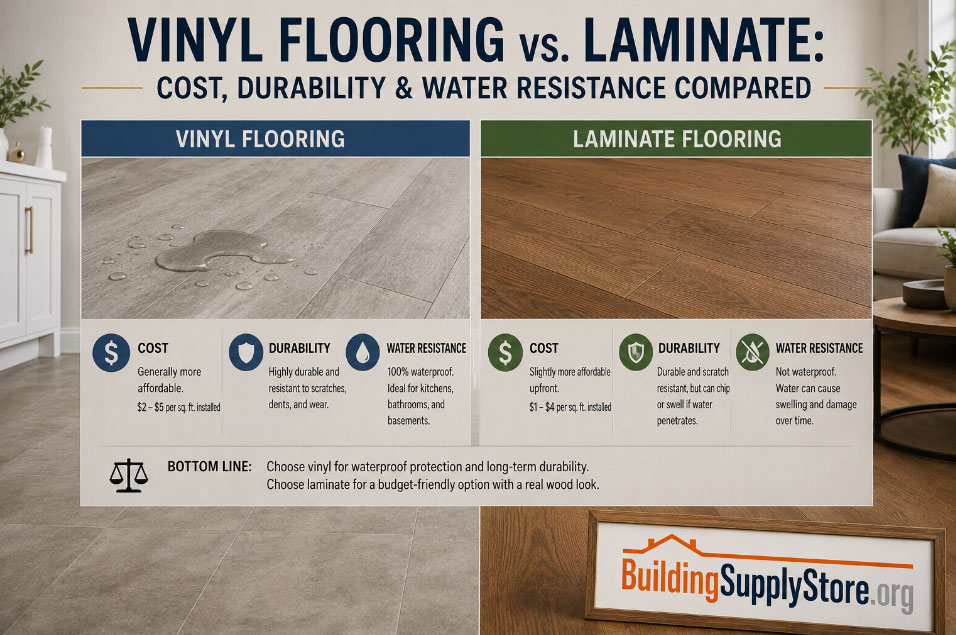
Flooring decisions rarely feel urgent until the moment they suddenly are — a burst pipe under the kitchen sink, a listing photo that needs to look sharper than the neighbor's, a toddler who has just discovered what happens when apple juice meets a rug. That's usually when vinyl and laminate end up on the same shortlist, because both promise the warmth of wood without the price tag or the maintenance schedule of the real thing.
They are not, however, the same product wearing two different names. Vinyl and laminate are built from different materials, tested against different standards, and suited to different rooms in your house. One is a plastic product engineered around water. The other is a wood-fiber product engineered around scratch resistance. Confusing the two — which happens constantly, even among people who sell flooring for a living — is how homeowners end up with a warped laminate floor in a mudroom or a vinyl floor that shows every dog-nail scratch in a hallway.
This guide breaks down where each material actually wins, using the numbers manufacturers and independent reviewers publish rather than showroom talking points.
What Vinyl Flooring Actually Is
Vinyl flooring is a synthetic, PVC-based product built in layers: a base or core layer, a printed design layer that mimics wood grain or stone, and a clear wear layer on top that protects the print from scuffs and sun fading. It comes in a few distinct formats, and the format matters more than most buyers realize.
- Sheet vinyl — large rolled sheets, glued or loose-laid, with almost no seams. It's the least expensive option and the most water-secure by design, since there are fewer joints for moisture to find.
- Luxury vinyl tile (LVT) — individual tiles designed to mimic stone or ceramic, often installed in a grid pattern with grout-look seams.
- Luxury vinyl plank (LVP) — plank-shaped pieces that mimic hardwood, typically installed with a click-lock floating system. This is the format driving most of vinyl's growth over the last several years.
- Rigid-core vinyl (SPC and WPC) — the newer generation of LVP, built around a stone-plastic composite (SPC) or wood-plastic composite (WPC) core instead of a flexible vinyl backing.
SPC and WPC are worth understanding on their own, because "vinyl" now covers products with very different personalities underfoot. WPC cores run thicker, generally between 5.5 and 8 millimeters, while SPC cores run thinner, typically 3.2 to 7 millimeters. SPC is denser and more rigid, which makes it the sturdier pick for heavy furniture and rolling office chairs. WPC has a foaming agent in its core that gives it a slightly softer, quieter feel, which people tend to prefer in bedrooms and living rooms.
What Laminate Flooring Actually Is
Laminate is a different animal entirely. Instead of PVC, its core is high-density fiberboard (HDF) — compressed wood fibers — topped with a photographic image layer and a hard, transparent wear layer infused with aluminum oxide. The whole assembly is fused together under heat and pressure, which is where the name comes from.
Because the core is wood-based rather than plastic, laminate has always had a moisture problem. That core swells if it absorbs water, and once it swells, it doesn't shrink back. Manufacturers have made real progress with water-resistant laminate lines built around denser, treated HDF cores, but even the best of them are describing themselves as resistant, not waterproof, and that distinction is the single most important thing to understand before you buy.
Laminate's durability is measured with a different yardstick than vinyl's, and this is where a lot of comparison articles get sloppy.
The AC Rating System, Explained Simply
Laminate durability is scored using the AC (Abrasion Class) rating, a standard developed by the European Producers of Laminate Flooring under the EN 13329 standard and mirrored in North America by NALFA testing. An AC rating measures how well a laminate floor's wear layer resists scratches, foot traffic, impact, and general abrasion — not its thickness and not its water resistance.
- AC1–AC2: Light residential use — closets, guest rooms, spaces that rarely see foot traffic.
- AC3: Heavy residential and light commercial use — the standard choice for most living rooms and bedrooms.
- AC4: General commercial use — offices, small retail spaces, and busy family homes with kids or pets.
- AC5–AC6: Heavy commercial use — shopping centers and airports, well beyond what a home needs.
For a typical household, AC3 covers most rooms comfortably, and AC4 is the safer bet for kitchens, entryways, or homes with dogs.
Cost Comparison: What You'll Actually Spend
Sticker price is where most people start, and the honest answer is that vinyl and laminate overlap more than either camp likes to admit. The real difference shows up at the extremes — the cheapest sheet vinyl versus the cheapest laminate, and premium rigid-core vinyl versus premium laminate.
At the entry level, laminate flooring costs $4 to $14 per square foot installed, while vinyl flooring runs $2 to $16 per square foot installed depending on the type chosen. Independent contractor-quote aggregators tend to report tighter, lower ranges: professional vinyl plank installation typically runs $2 to $10 per square foot, with laminate averaging $6 to $14 per square foot including material and labor.
Broken down by product tier:
- Sheet vinyl: roughly $0.75–$2 per square foot installed — the cheapest hard-surface flooring on the market.
- Standard laminate (7mm planks): starting around $1 per square foot for materials, scaling toward $5 for thicker 12mm planks.
- LVP/LVT (standard grade): about $2–$7 per square foot installed.
- Premium rigid-core vinyl (SPC/WPC) and premium laminate: both land in the $5–$10+ range, where the price gap narrows to a matter of brand and finish rather than material category.
A few cost factors apply to both materials equally and are easy to forget when budgeting: underlayment, transition strips at doorways, moisture testing on concrete subfloors, and the cost of removing whatever flooring you're replacing. On a 200-square-foot room, those add-ons commonly tack on several hundred dollars regardless of which material you pick.
The Lifetime-Cost Angle Nobody Mentions
Sticker price only tells half the story. Laminate that swells from a laundry-room leak needs full plank replacement, and matching an eight-year-old laminate color is close to impossible. Vinyl that survives the same leak needs nothing but a mop. If your home has any real moisture risk — a basement, a slab foundation in a humid climate, kids who leave the tub running — the cheaper laminate floor can become the more expensive choice within a few years.
Durability Comparison: Scratches, Dents, and Daily Wear
Durability splits into two separate questions: how well does the surface resist scratches, and how well does the whole plank resist denting or crushing under weight? Vinyl and laminate answer these questions differently.
Scratch resistance generally favors laminate. Its aluminum-oxide wear layer is harder than vinyl's surface coating, and tiny scratches from pet nails or shoe scuffs tend to show up faster on vinyl than on laminate. If you have large dogs or you're outfitting a home office with a rolling chair on hard casters, laminate's surface hardness is a real advantage.
Dent and impact resistance, on the other hand, tends to favor rigid-core vinyl, particularly SPC. An SPC plank with a thick wear layer resists dents from dropped objects and daily foot traffic exceptionally well, largely because its stone-composite core doesn't compress the way a softer material would.
Vinyl's own durability metric is the wear layer, measured in mils (thousandths of an inch) rather than the AC scale:
- 6–8 mil: Budget-tier, best for low-traffic guest rooms. Expect roughly a decade of good looks before wear starts to show.
- 12 mil: A solid baseline for a typical family home and moderate traffic.
- 20 mil: The sweet spot for families with pets — durable enough for long-term protection without paying for commercial-grade specs you don't need.
- 28+ mil: Commercial-grade protection, more than most residential spaces require.
Lifespan estimates land in a similar range for both materials when properly rated for the room: both vinyl plank and laminate are commonly rated for 15 to 25 years of service life, though premium rigid-core vinyl with a thick wear layer can stretch toward the higher end of that window, and laminate below AC3 tends to fall short of it in busy households.
Water Resistance: The Question That Should Decide Everything
This is where the two materials genuinely diverge, and it's the single factor that should carry the most weight in a bathroom, kitchen, laundry room, or basement decision.
Vinyl, especially the rigid-core SPC and WPC formats, is engineered to be fully waterproof — not water-resistant, waterproof. An SPC core won't ripple, swell, or stain no matter how much liquid it's exposed to, and WPC cores are built the same way, resisting swelling and warping regardless of moisture exposure. Water can sit on a quality vinyl floor for hours without consequence, which is precisely why it dominates in bathrooms and basements.
Laminate cannot make the same claim, even in its newer "water-resistant" product lines. Vinyl is fully waterproof, while laminate resists moisture but can still warp if water sits on the surface too long or seeps into the seams between planks. The wood-fiber HDF core is the vulnerability — treated cores slow water absorption, but they don't eliminate it. A spill wiped up within minutes is rarely a problem; a dishwasher leak discovered a week later usually is.
There's also a subfloor consideration worth flagging: on concrete slabs and in basements, SPC's solid, dense structure eliminates the risk of moisture-driven expansion that can affect WPC cores over long-term exposure to high humidity, which is part of why SPC is often the specific vinyl format recommended for below-grade installations.
Bottom line: if a room has any regular exposure to standing water — a bathroom, a laundry room, a mudroom, a basement — rigid-core vinyl is the materially safer choice. Laminate belongs in rooms where spills are occasional and get cleaned up quickly.
Vinyl vs. Laminate: Side-by-Side Comparison
| Feature | Vinyl Flooring (LVP/LVT/SPC/WPC) | Laminate Flooring |
|---|---|---|
| Installed cost range | $2–$16 per sq. ft. | $4–$14 per sq. ft. |
| Core material | PVC, stone-plastic composite, or wood-plastic composite | High-density fiberboard (HDF) |
| Durability rating system | Wear layer thickness (mil) | AC rating (AC1–AC6) |
| Water resistance | Waterproof (rigid-core types) | Water-resistant at best; can warp with prolonged exposure |
| Best for | Bathrooms, kitchens, basements, laundry rooms | Living rooms, bedrooms, dining rooms, offices |
| Scratch resistance | Good, but softer surface shows wear sooner | Very good — hard aluminum-oxide wear layer |
| Feel underfoot | Softer (WPC), quieter, can feel cold | Warmer, thicker, but can sound hollow when walked on |
| Realistic wood/stone look | Excellent, especially premium LVP | Slightly edges vinyl in photographic realism and texture |
| Typical lifespan | 15–25 years, up to 30 for premium rigid-core | 15–25 years, shorter if under-rated for the room |
| DIY installation | Easy — click-lock and peel-and-stick options | Easy — click-lock floating floor system |
| Repairability | Individual planks/tiles often replaceable | Individual planks replaceable, but color matching is difficult over time |
| Resale value impact | Minimal — realtors generally recommend real wood for value | Minimal — same caveat applies |
Installation and Maintenance
Both materials were largely built for DIY installers, and both use floating, click-lock systems that don't require nails, staples, or (in most cases) glue. A reasonably capable installer can lay 400–600 square feet of either material in a day, so labor costs land in a similar range whichever you choose.
Maintenance is where vinyl pulls slightly ahead for busy households. Its non-porous surface wipes clean with a damp mop and mild cleaner, and because it doesn't absorb moisture, there's no need to baby it during mopping. Laminate needs a lighter touch — a damp (not wet) mop, cleaners formulated specifically for laminate, and prompt attention to any spill before it has time to sit at a seam.
Comfort, Sound, and Look
Underfoot feel is genuinely subjective, but the general pattern reported across installers and reviewers is consistent: laminate tends to feel warmer and more substantial underfoot due to its thicker construction, though it can be louder to walk on, while vinyl feels cooler and harder but is typically quieter. WPC vinyl narrows that gap somewhat, since its foamed core adds cushioning that flexible sheet vinyl and rigid SPC don't have.
On looks, the margin is thin enough that photographs from the best product lines in each category are hard to tell apart. Laminate has a slight edge in realistic texture and grain resembling hardwood, ceramic, or stone, largely because its embossed-in-register printing process aligns texture with the photographic pattern more precisely than most vinyl. Premium LVP has closed that gap considerably, though, and at the top end of both categories, the difference comes down to the specific product line rather than the material itself.
Indoor Air Quality and Environmental Considerations
Both materials have moved past their reputations from a decade ago, but neither is entirely free of the VOC (volatile organic compound) conversation. Concerns about VOC emissions from PVC-based vinyl products led to the development of the FloorScore certification by the Resilient Floor Covering Institute, which rates indoor air quality impact. Laminate carries its own version of the same concern, tied to the adhesives and resins used in the HDF core and finish.
The practical takeaway for either material is the same: look for third-party certifications — FloorScore, GREENGUARD Gold, or CARB compliance — rather than taking a "low-VOC" label at face value, and ventilate the space for the first day or two after installation.
On longevity and resale, neither material moves the needle much. Laminate does not improve a home's resale value the way hardwood does, and vinyl doesn't add much resale value either — most realtors still point to real wood as the flooring that actually influences a buyer's offer. If resale value is the primary goal, both vinyl and laminate should be treated as practical, budget-conscious choices rather than investment upgrades.
Room-by-Room: Where Each Material Makes Sense
- Bathrooms: Vinyl, no real contest. Rigid-core SPC handles standing water around tubs and toilets without risk.
- Kitchens: Vinyl is the safer default given dishwasher and sink leak risk, though AC4+ water-resistant laminate can work if spills are attended to quickly.
- Basements: Vinyl, specifically SPC, due to its resistance to humidity-driven expansion on concrete slabs.
- Bedrooms: Either works well; laminate's slightly warmer feel is a nice fit here, or WPC vinyl if you want a quieter, softer step.
- Living rooms and dining rooms: Either material performs well; choose based on aesthetic preference and budget rather than function.
- Laundry rooms and mudrooms: Vinyl, given the near-certainty of water and debris tracked in from outside.
- Home offices with rolling chairs: SPC vinyl or AC4 laminate — both resist the wear rolling chair casters cause, though a chair mat is still worth the few dollars either way.
Frequently Asked Questions
Is vinyl flooring better than laminate overall?
Neither is universally "better" — they solve different problems. Vinyl is the stronger choice anywhere water is a real risk, while laminate offers a slightly more realistic wood look and a warmer feel underfoot for dry, low-moisture rooms.
Can laminate flooring get wet at all?
Water-resistant laminate can handle brief spills if they're wiped up promptly, but it is not built for standing water. Prolonged exposure — a slow leak, a flooded basement, water left on the seams overnight — will cause the HDF core to swell.
Which lasts longer, vinyl or laminate?
Both are commonly rated for 15 to 25 years under normal residential use. Premium rigid-core vinyl with a thick wear layer can edge past that range, while laminate below AC3 in a high-traffic home often falls short of it.
Does vinyl or laminate flooring add more value to a home?
Neither adds significant resale value compared to hardwood. Both are considered practical, budget-friendly options rather than value-adding upgrades, so the choice should be based on function and personal preference rather than resale strategy.
What's the difference between SPC and WPC vinyl?
SPC (stone-plastic composite) has a denser, more rigid core that's thinner and more resistant to denting — a strong choice for basements and high-traffic areas. WPC (wood-plastic composite) has a thicker, foam-enhanced core that feels softer and quieter underfoot, better suited to bedrooms and living rooms.
Is laminate cheaper than vinyl?
At the entry level, yes — basic 7mm laminate can start below $1 per square foot for materials alone, undercutting most vinyl. At the premium end, the two categories cost about the same, and high-end vinyl can actually run cheaper than high-end laminate once installation is included.
Making the Call
If there's a single rule worth remembering after all the numbers, it's this: let the room decide, not the showroom sample. Water risk is the one variable that has a genuinely correct answer — vinyl for anywhere moisture is a real possibility, laminate for anywhere it isn't. Everything else — cost, texture, underfoot feel — is close enough between the two that personal preference and the specific product line matter more than the broad category you start with.
For a deeper look at product-specific ratings and installer-reported pricing in your area, these resources are worth a visit before you buy:
- HomeGuide: Laminate vs. Vinyl Flooring Costs
- Angi: Laminate vs. Vinyl Flooring Comparison
- Bob Vila: Laminate vs. Vinyl Flooring Cost Factors
- Fixr: Vinyl vs. Laminate Flooring Pros, Cons, and Costs
- HomeAdvisor: Vinyl Flooring Installation Cost Guide
- BuildDirect: SPC vs. WPC Vinyl Flooring
- Carpets of Dalton: Understanding Laminate AC Ratings
Prices, ratings, and terminology in this guide reflect industry-standard sourcing as of 2026. Always confirm current specs and local installed pricing with the manufacturer or installer before purchasing, since costs vary by region and season.