
Door Handle Finishes Guide: Matching Hardware to Your Home's Style
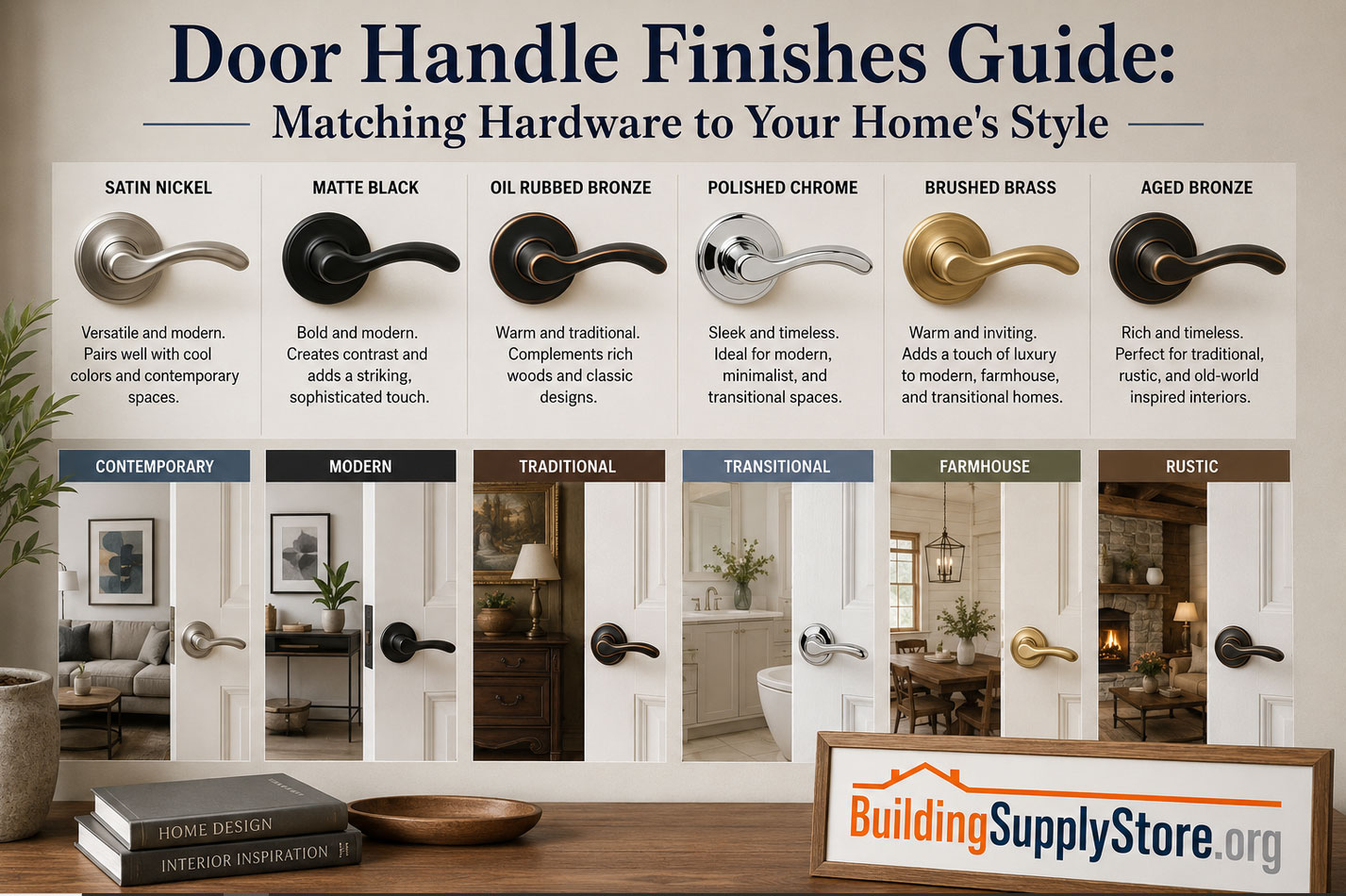
Door handles are the one piece of a house that every single person touches. Not sees — touches. You can walk past a light fixture or a rug without registering it, but you cannot get from one room to another without your hand closing around a lever or a knob. That small, repeated contact is why a finish decision that seems minor on a spec sheet ends up shaping how an entire home feels.
This guide breaks down the major door handle finishes, how they read against different architectural styles, and how to choose one that will still look right in ten years — not just on the day the plastic wrapping comes off.
Why Door Handle Finish Matters More Than You Think
A door handle is jewelry for a house. It's small, it's metal, and it's the detail people notice without being able to say exactly why a room feels "finished" or "off." Two identical lever sets in two different finishes will read as two completely different design decisions — one modern, one traditional — even though the shape underneath is exactly the same.
Finish also does something a floor plan can't: it sets expectations before a guest even steps inside. A matte black entry set on a white door reads contemporary and confident. An aged brass knob on that same door reads collected, historic, maybe even a little formal. Neither is right or wrong. They're just telling two different stories, and the story needs to match the rest of the house or the hardware will feel like a costume rather than a choice.
Finally, finish is a durability decision disguised as an aesthetic one. Some finishes are plated and will wear thin at contact points within a few years. Others are solid metal that ages into something better than new. Knowing the difference before you buy saves a second renovation five years down the line.
Understanding the Language of Finishes
Hardware catalogs use finish names inconsistently, so it helps to know what you're actually looking at underneath the marketing language.
Polished Chrome
Bright, reflective, cool-toned, and unapologetically shiny. Chrome has been a bathroom and kitchen staple for a century because it resists tarnish and cleans up with a wipe. It pairs naturally with glass, white marble, and crisp modern lines, but it can look sterile in a room full of warm wood tones.
Brushed or Satin Nickel
The workhorse finish of the last two decades. Brushed nickel has a soft, low-glare sheen that hides fingerprints far better than chrome and sits comfortably between warm and cool, which is exactly why it shows up in so many transitional and contemporary homes. It's forgiving, widely available, and easy to match across brands.
Oil-Rubbed Bronze
A dark, almost chocolate-brown finish with lighter highlights where the coating catches the light. Oil-rubbed bronze became the default "traditional" finish of the 2000s and 2010s, and for good reason — it hides smudges, ages gracefully, and reads as substantial. Lower-quality versions are a sprayed coating that can wear through at high-touch points; better ones are a genuine oxidized patina over solid bronze.
Matte Black
The finish that defined the last decade of interior design. Matte black is graphic, modern, and works as a strong accent against almost any wall color. It's less forgiving of fingerprints than a textured finish, and cheaper powder-coated versions can chip, so it's worth paying for a quality PVD (physical vapor deposition) coating if you want it to last.
Unlacquered and Living Brass
This is solid brass left without a protective topcoat, which means it darkens and develops a patina with use — hands, weather, and time change its color gradually. Designers love it because it ages like leather rather than like plastic: the wear pattern becomes part of the story of the house. It requires patience from the homeowner, since a shiny showroom sample will not stay shiny.
Polished Brass
The lacquered, mirror-bright cousin of unlacquered brass. This finish fell out of fashion in the 1990s and has been quietly returning, especially in more maximalist and "grandmillennial" interiors. A protective lacquer keeps it gleaming without the patina, though the coating will eventually need refinishing.
Pewter, Bronze, and Dark Patinas
Deep gray-browns and near-black bronzes sit at the intersection of traditional and industrial. These finishes often use real metallurgical patination rather than paint, meaning small scratches blend in rather than standing out — a practical advantage for busy front doors.
Stainless Steel
Cool, bright, and slightly more silvery-gray than chrome, with a texture that ranges from mirror-polished to brushed. It's the natural choice for commercial-leaning or minimalist kitchens and reads as unmistakably contemporary.
Warm Copper and Aged Metals
Copper and its aged variations bring a rosy, warm undertone that works beautifully with terracotta, wood, and earth-toned interiors. It's a less common choice, which makes it a distinctive one for a home that wants to stand apart from the brushed-nickel default.
Matching Finishes to Architectural Style
Hardware should agree with the bones of a house, not fight them.
Modern and Minimalist
Matte black, brushed stainless, and polished chrome all suit clean lines and unornamented doors. Lever handles with sharp, geometric silhouettes reinforce the architecture rather than distracting from it.
Traditional and Colonial
Polished or unlacquered brass, oil-rubbed bronze, and aged pewter feel appropriately formal against paneled doors, crown molding, and symmetrical facades. Rosette-style backplates read more historically accurate than modern lever sets.
Farmhouse and Rustic
Matte black and oil-rubbed bronze dominate this category for good reason — they read as hand-forged and unfussy, especially paired with barn-style doors, shiplap, and reclaimed wood.
Mid-Century Modern
Warm brass, satin brass, and walnut-toned wood pulls suit the era's love of warm materials and low, horizontal lines. Avoid anything too polished or too rustic; mid-century hardware tends to sit in a confident middle ground.
Coastal and Cottage
Brushed nickel, polished chrome, and unlacquered brass that will patina softly all work well here, especially against white trim and light-washed wood.
Industrial Loft
Raw or blackened steel, aged bronze, and matte black hardware with visible hardware mechanisms (exposed screws, chunky levers) suit exposed brick and concrete.
Transitional
This is brushed nickel's home turf — a finish specifically designed to bridge traditional shapes with contemporary neutrality, which is why it remains the best-selling finish category across most major hardware brands.
Mixing Metals Without Making a Mess
Sticking to one finish throughout an entire house is safe, but it isn't a rule you have to follow. Most well-designed homes mix two, occasionally three, finishes with intention.
A reliable approach is to pick one dominant finish for door hardware throughout the main living areas, then allow a second finish to appear in fixtures — faucets, lighting, cabinet pulls — that are visually separated from the door hardware by distance or by room. A matte black front door set and brushed nickel interior levers rarely clash, because you never see both at once.
The riskiest mixing happens within a single sightline: a brass door lever next to a chrome light switch plate on the same wall will read as an accident rather than a decision. When in doubt, keep everything visible from one spot in the same finish family, and save contrast for rooms that are physically separate.
Finish and Function: Durability Considerations
Not all finishes age the same way, and the difference matters more in high-traffic households.
Plated finishes — a thin metal or lacquer coating over a base material — are more affordable but can wear through at contact points within a few years, especially on a front door lever that gets gripped daily. Look for hardware described as PVD-coated, which is a more durable vacuum-deposited finish that resists scratching far better than traditional electroplating.
Solid, unlacquered metals — living brass, bronze, and pewter — behave differently. They don't wear thin because there's no thin coating to wear through; the entire piece is the same material throughout. Instead, they develop a patina, which is a feature rather than a flaw for anyone who likes the look of hardware that visibly ages.
Powder-coated matte black is durable against everyday wear but can chip if struck hard, exposing a different-colored base metal underneath. Ask about the coating process before buying an exterior matte black set that will face weather as well as daily use.
How Lighting Changes the Way a Finish Reads
The same lever set can look like two different products depending on what kind of light is hitting it, and this is the single biggest reason online hardware orders end up returned.
Warm, incandescent-style bulbs (anything in the 2700K–3000K range) push nickel and chrome toward a slightly golden cast and make brass and bronze look even richer. Cooler LED lighting, common in newer kitchens and bathrooms, pulls the opposite direction — it can make warm brass look flatter and makes cool-toned finishes like chrome and stainless steel look crisper and more clinical.
North-facing rooms tend to receive cooler, bluer daylight, which favors chrome, nickel, and stainless. South-facing rooms receive warmer daylight for more of the day, which flatters brass, bronze, and copper tones. None of this means a finish is off-limits in the "wrong" light — it simply means the finish will read slightly differently than it did in a showroom lit for maximum sparkle, so it's worth holding a physical sample in the actual room, at the actual time of day, before finalizing an order.
Sustainability and Longevity as a Design Factor
Finish choice has an environmental dimension that rarely makes it into hardware marketing. A cheap plated finish that wears through in three years generates a replacement purchase, additional shipping, and a piece of hardware headed to a landfill. A solid, unlacquered metal that simply patinas with age never needs replacing for cosmetic reasons — it improves rather than degrades, which is about as close to a maintenance-free product as home hardware gets.
Several premium manufacturers now highlight recycled metal content and domestic manufacturing as selling points alongside finish options, which is worth asking about if the sourcing of materials matters to a renovation's overall goals. A hardware set that lasts twenty-five years without cosmetic failure is, in a very literal sense, a more sustainable choice than one that needs replacing twice in that span, regardless of what either was made from originally.
Room-by-Room Finish Strategy
Front Door and Entry
This is the hardware that greets every guest, so it earns the highest budget and the most durable finish. Solid bronze, unlacquered brass, and quality matte black PVD coatings all hold up to weather and daily use far better than budget plated finishes.
Kitchen
Match door and cabinet hardware to the finish of the faucet where possible — it's the fixture most people look at while cooking, and mismatched metals here are the most noticeable mismatch in the house.
Bathroom
Moisture accelerates wear on plated finishes, so solid metals or high-quality PVD coatings are worth the investment, particularly on levers near the shower.
Bedroom
Bedrooms carry the lowest traffic and the most freedom — a softer or more decorative finish that wouldn't survive a mudroom door can live happily here.
Interior Flow
Consistency across interior doors on the same floor reads as intentional; switching finishes room to room down a single hallway reads as leftover inventory from three different renovations.
Where to See and Source Finishes in Person
Photographs online flatten metal finishes into something they're not — a brushed nickel photographed under warm light can look almost gold, and a matte black photographed under fluorescent light can look navy. Seeing a finish under your own lighting, or at least under a showroom's varied lighting, prevents an expensive guessing game.
A few well-regarded hardware showrooms worth visiting or browsing:
- Rejuvenation — 1100 SE Grand Ave, Portland, OR 97214. Known for reproduction and heritage-style hardware finishes, particularly warm brass and bronze tones suited to traditional and craftsman homes.
- Rocky Mountain Hardware — showroom at 315 N. La Brea Ave, Los Angeles, CA 90036. Specializes in hand-cast bronze hardware with a wide range of artisan patina finishes, well suited to mountain, rustic, and high-end traditional interiors.
- NANZ & Company — 121 Varick Street, 10th Floor, New York, NY 10013 (by appointment). Custom fine hardware with an extensive finish library, popular with architects and interior designers working on historic renovations.
- Emtek — a widely distributed mid-to-premium brand with consistent finish naming across a large catalog, useful for comparing the same finish across multiple hardware styles.
- Baldwin Hardware — a long-established American brand known for solid brass construction and a broad range of both historic and contemporary finishes.
- House of Antique Hardware — a strong resource for finishes matched to specific historic periods, from Victorian to Arts and Crafts to mid-century.
Ordering a single finish sample before committing to an entire house's worth of hardware is a small expense that prevents a very large regret.
Budget Tiers and What You're Paying For
Door hardware finish pricing tends to fall into three rough tiers, and knowing what separates them helps explain why two visually similar levers can cost very different amounts.
Entry-level hardware typically uses a zinc alloy base with a plated finish. It looks correct on day one but is the most likely to show wear within a few years of daily use, particularly at an exterior entry.
Mid-range hardware often uses solid brass or bronze construction with a durable PVD or baked-on finish. This tier represents the best value for most homeowners — genuine metal underneath, a coating designed to resist wear, and a price point well below custom work.
Premium and custom hardware, the kind found at boutique showrooms, uses hand-finished solid metal with artisan patina work. Pricing reflects labor as much as material, and the payoff is a finish that improves with age rather than merely resisting it.
It's worth noting that finish, not shape, is usually the bigger price driver within a single product line. Two levers with the exact same silhouette can sit two or three pricing tiers apart depending on whether the finish is a sprayed coating, an electroplated layer, a PVD coating, or a hand-applied living patina — so it pays to ask a showroom specifically what process created the finish in front of you, rather than assuming price scales only with design complexity.
Common Mistakes to Avoid
A few patterns show up again and again in finish decisions gone wrong.
Choosing a finish from a small catalog swatch rather than a full-size sample under home lighting is the single most common regret — metal finishes shift dramatically under different light temperatures.
Matching hardware to trend rather than to the house's actual architecture leads to a home that will look dated the moment the trend passes, while a finish chosen to suit the architecture ages more gracefully because it was never chasing a moment to begin with.
Buying the cheapest available plated finish for a heavily used exterior door is a false economy — the replacement cost and reinstallation labor a few years later usually exceeds what a mid-range solid finish would have cost upfront.
Ignoring sightlines when mixing metals creates visual noise in exactly the spots where a home should feel calm, such as an entryway where three different finishes are visible from the same standing position.
Frequently Asked Questions
What is the most popular door handle finish right now? Matte black and brushed nickel remain the two most widely purchased finishes across major hardware brands, with warm, unlacquered brass steadily gaining ground as homeowners move away from uniformly cool, monochrome interiors.
Should all the door handles in a house match? Not necessarily. Interior doors within the same sightline should generally share a finish, but it's common and often intentional to use one finish for interior doors and a different, more durable finish for the front entry.
Can you mix matte black and brushed nickel in the same house? Yes, as long as the two finishes are separated by room or by distance rather than appearing side by side in the same view. Mixing works best when each finish gets its own zone of the house.
Does door handle finish need to match cabinet hardware? It helps but isn't mandatory. Matching or closely coordinating finishes between door levers, cabinet pulls, and faucets in the same room creates a more cohesive look, though many well-designed kitchens intentionally use a secondary finish for cabinet hardware as an accent.
What finish holds up best on a front door? Solid, unlacquered metals and high-quality PVD-coated matte black tend to outperform standard plated finishes on an exterior door, since they're exposed to the most daily contact and the most weather.
Is unlacquered brass hard to maintain? It requires no special maintenance — the gradual darkening and spotting is the intended look. Homeowners who want brass to stay permanently bright should choose a lacquered or PVD-coated version instead.
How many finish samples should I order before deciding? Two or three real-world contenders is usually enough. Ordering a single sample and comparing it only against a screen tends to produce disappointment, since screens rarely render metallic finishes accurately; comparing physical samples against each other, in the room where they'll live, is the more reliable test.
Closing Thoughts
A door handle is a small object carrying an outsized amount of information about a house — its age, its ambitions, and how carefully everything else was chosen. Getting the finish right isn't about following whatever is trending this year; it's about picking metal that will keep agreeing with the house long after the trend has moved on. Start with the architecture, test a real sample under real light, and let function guide the final call on the doors that take the heaviest daily use.