
Signs You Need a Roof Repair vs. a Full Replacement: A Homeowner's Decision Guide
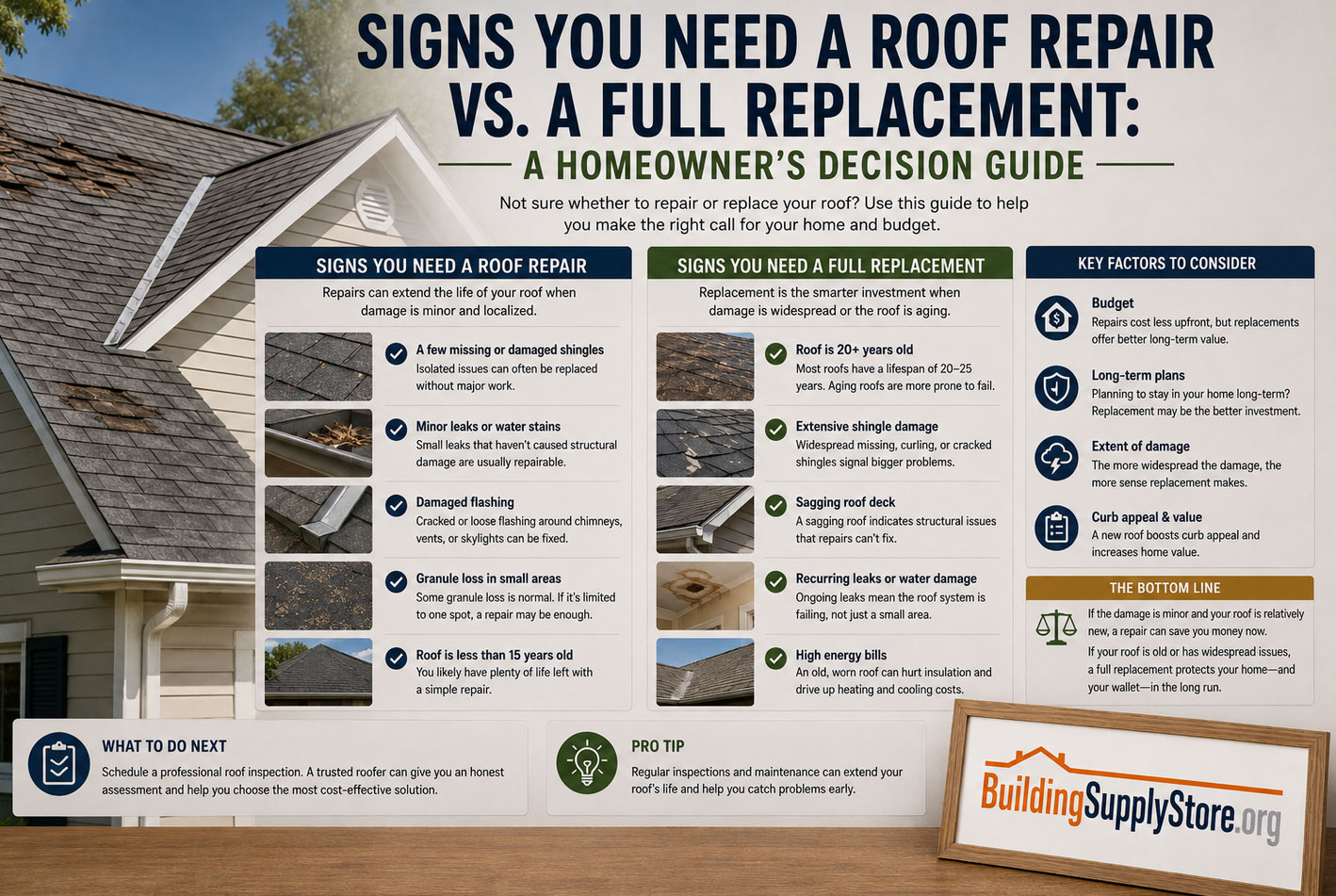
Every homeowner eventually stands in their driveway, squinting up at a roof that doesn't look quite right, wondering whether they're looking at a $400 fix or a $14,000 problem. That gap — between "call a repair guy" and "call three contractors for quotes" — is where a lot of money gets wasted, either through unnecessary full replacements or through repeated patch jobs on a roof that was never going to survive another winter anyway.
This guide breaks down exactly how professional roofers, insurance adjusters, and home inspectors make that call, so you can walk into the conversation with a contractor already knowing roughly where you stand.
Why Getting This Decision Right Actually Matters
A roof repair might run anywhere from $150 to $1,500 depending on the scope. A full replacement, depending on square footage, material, and region, typically lands between $8,000 and $25,000, and can climb well past that for slate, tile, or metal. That's not a small spread, and it's exactly why the decision deserves more than a quick glance from the ground.
There's a second cost that's easy to overlook: the cost of delay. A roof that needs replacing but only gets patched will keep leaking in new places, and water doesn't stay where it lands. It travels along rafters, pools in insulation, and shows up as a stain on a ceiling two rooms away from the actual entry point. By the time interior damage appears, you're often looking at drywall repair, mold remediation, and ruined insulation on top of the roofing bill itself.
On the flip side, replacing a roof that only needed a repair is its own kind of waste — thousands of dollars spent on a problem that a competent roofer could have solved in an afternoon.
What "Repair" and "Replacement" Actually Mean
It helps to define terms before going further, because contractors use these words more precisely than homeowners often expect.
Roof repair refers to fixing a specific, localized problem — a handful of cracked shingles, a leak around a chimney, a section of damaged flashing — while leaving the rest of the roofing system intact. A good repair addresses the cause of a problem, not just the visible symptom.
Roof replacement means removing the existing roofing material down to the deck (or in some cases, layering a new layer over one existing layer, where code allows) and installing an entirely new roofing system. This includes new underlayment, flashing, ventilation components, and the surface material itself.
There's also a middle category worth knowing: a partial re-roof, where one slope or section of a roof — say, a garage addition or a section that faces the worst weather — gets fully replaced while the rest of the roof, which is in better shape, is left alone. This is common on additions built at different times than the main structure.
The Age Test: How Old Is Too Old?
Roof age is the single biggest factor in this decision, and it's the first thing any honest contractor will ask about. Materials degrade in fairly predictable patterns, which means age alone can rule replacement in or out before an inspector even climbs a ladder.
| Roofing Material | Typical Lifespan | When to Start Watching Closely |
|---|---|---|
| 3-tab asphalt shingles | 15–20 years | Year 12+ |
| Architectural (dimensional) shingles | 25–30 years | Year 18+ |
| Wood shakes | 20–30 years | Year 15+ |
| Clay or concrete tile | 40–60 years | Year 30+ |
| Standing seam metal | 40–70 years | Year 30+ |
| Slate | 75–100+ years | Year 50+ |
A roof within its first 10–15 years, showing isolated damage, is almost always a repair candidate. A roof past 20 years (for asphalt) showing multiple issues at once is usually past the point where repair makes financial sense — you're paying to patch a system that's failing broadly, not in one spot.
Signs That Point to Repair
These are the situations where a targeted fix genuinely solves the problem, and paying for a full tear-off would be overkill.
1. Isolated Shingle Damage
A handful of cracked, curling, or missing shingles in one area — often from a fallen branch, foot traffic, or a single wind event — is a textbook repair. If the surrounding shingles are still flat, granulated, and firmly attached, there's no reason to touch the rest of the roof.
2. A Single, Locatable Leak
If water is coming in at one identifiable point — around a vent pipe, a skylight, or a chimney — and the rest of the attic deck is dry, that's almost always a flashing or sealant failure, not a roof-wide problem. These are some of the most common and most fixable roofing issues out there.
3. Minor Flashing Failures
Flashing — the metal strips sealing joints around chimneys, vents, and roof valleys — degrades faster than the shingles around it. Rusted, lifted, or improperly sealed flashing is a frequent leak source and a straightforward repair, even on an otherwise healthy roof.
4. Granule Loss Confined to One Area
Some granule loss in gutters is normal, especially in the first year or two after installation as excess granules shed. But if it's concentrated in one section — say, after a hailstorm hit one side of the house harder than the other — a localized repair or partial re-roof usually handles it.
5. Storm Damage Limited to One Slope
When wind or hail damage is concentrated on the side of the roof facing the storm, and the opposite slope is untouched, insurance adjusters and roofers alike will often recommend repairing just that section, provided the shingles aren't so old that matching material is unavailable.
A quick illustrative example: a two-story colonial at 1420 Sycamore Lane had a windstorm rip a dozen shingles off the northwest-facing slope while the rest of the roof, installed nine years earlier, remained fully intact. The homeowner assumed the worst and started collecting replacement quotes. A roofer talked them out of it — the repair cost $380 and solved the problem completely.
Signs That Point to Full Replacement
These are the situations where repair isn't a real fix — it's a delay tactic that costs money now and more money later.
1. Widespread Shingle Curling or Cupping
When shingles across multiple sections of the roof are curling at the edges or cupping in the middle, that's a sign the asphalt has lost its oils and flexibility roof-wide, not just in one spot. This is age-related degradation, and patching individual shingles won't stop the rest from following the same path within a year or two.
2. Leaks Appearing in Multiple, Unrelated Locations
One leak is a repair. Three or four leaks in different rooms, especially after different storms, usually means the underlayment — the waterproof barrier beneath the shingles — has failed broadly. Chasing each leak individually becomes a losing, expensive game.
3. A Sagging Roofline
Any visible sag, dip, or wave in the roofline, viewed from the street, is a structural red flag. This can indicate deteriorated decking, compromised rafters, or long-term moisture damage, and it needs a structural assessment, not a shingle patch.
4. Daylight Visible Through the Roof Deck
If you can go into the attic during daylight hours and see light coming through gaps in the roof boards, water has almost certainly been getting in the same way. This typically means the deck itself needs replacing, which requires a full tear-off.
5. A History of Repeated Repairs That Keep Failing
If the same section of roof has been patched two or three times in a few years and keeps leaking again, the underlying material has likely failed system-wide, and the "repairs" have just been treating symptoms. At this point, continuing to repair is throwing money at a roof that's already told you it's done.
6. Noticeably Rising Heating and Cooling Bills
Failing roof ventilation and insulation, often tied to an aging roof system, can quietly inflate energy bills by letting conditioned air escape and outside air infiltrate. If bills have crept up with no other explanation, an old, failing roof is a reasonable suspect.
7. Roof Age Beyond Its Material Lifespan, Combined With Any of the Above
Age alone doesn't always mean replace. But age plus even one or two of the signs above — that combination is usually decisive.
Another illustrative case: a ranch-style home near 88 Fernwood Court had three separate leak repairs over four years, each in a different part of the house. The fourth contractor to visit pulled back a section of shingles, found the underlayment disintegrating across the entire roof, and recommended full replacement. The homeowner had spent roughly $2,100 on repairs that, in hindsight, only delayed an $11,000 replacement that was coming regardless.
Repair vs. Replacement: Side-by-Side Comparison
| Factor | Repair Makes Sense | Replacement Makes Sense |
|---|---|---|
| Roof age | Under 15 years (asphalt) | Past 20–25 years (asphalt) |
| Damage location | Isolated to one area or slope | Spread across multiple sections |
| Leak pattern | Single, identifiable source | Multiple leaks, different rooms |
| Shingle condition | Mostly flat, granulated, intact | Widespread curling, cupping, bald spots |
| Decking condition | Solid, no soft spots | Soft spots, sagging, visible light through boards |
| Repair history | First or second repair | Third-plus repair on same issue |
| Storm damage | Limited to one slope | Affects entire roof or structure |
| Energy bills | Stable | Rising with no other explanation |
| Cost estimate | $150–$1,500 typical | $8,000–$25,000+ typical |
| Insurance likelihood | Partial claim, if any | Often a full claim if storm-related |
What a Professional Inspection Actually Checks
A homeowner walking the yard and looking up can catch obvious problems, but a real inspection goes further, and knowing what's involved helps you evaluate whether a contractor is doing a thorough job or a rushed sales pitch.
A proper inspection typically includes: a walk of the roof surface itself (not just binoculars from the ground), a check of flashing at every penetration point, an attic inspection for water stains, mold, or daylight through the deck, a look at granule accumulation in gutters and downspouts, a check of ventilation components like ridge vents and soffit vents, and a moisture reading on the decking in suspect areas using a moisture meter.
Organizations like the National Roofing Contractors Association publish standards that most reputable roofers train against, and homeowners can use those standards as a benchmark when comparing quotes — if a contractor skips the attic entirely, that's worth asking about.
Material Matters: Why Your Roofing Type Changes the Math
Not all roofing systems age the same way, and the repair-versus-replace calculus shifts depending on what's actually up there.
Asphalt shingles are the most common material in North America and also the most repair-friendly early in their life, since individual shingles can be swapped without disturbing the rest. Metal roofing, by contrast, is often repaired via sealant and panel replacement rather than shingle-by-shingle work, and tends to have a much longer runway before replacement becomes necessary. Tile and slate roofs are durable for decades but individual tiles are fragile underfoot, meaning even a small repair sometimes requires a specialist rather than a general roofer.
Manufacturers like GAF and IKO publish material-specific lifespan and warranty information that's worth cross-referencing against your roof's age, especially if you still have the original installation paperwork.
Local Climate: Why Where You Live Changes the Answer
The same roof, in the same condition, gets a different recommendation depending on climate. In regions with heavy snow load, repeated freeze-thaw cycles accelerate shingle cracking and ice-dam-related leaks, which can push replacement timelines earlier than the material's rated lifespan would suggest. In hot, sun-intensive climates, UV exposure dries out asphalt oils faster, leading to earlier curling and brittleness. Coastal areas deal with wind-driven rain finding its way under improperly sealed flashing, and salt air that corrodes metal components faster than inland environments.
If you're unsure how your local climate affects roofing lifespan, Energy Star and This Old House both maintain regionally specific guidance on roofing material selection and maintenance timing that's worth a look before your next roof-related decision.
The Insurance Question
Storm-related roof damage sometimes qualifies for a homeowners insurance claim, which changes the financial equation significantly. Insurers generally distinguish between damage caused by a specific, datable event (hail, wind, a fallen tree) and damage from gradual wear and tear, which is typically excluded from coverage.
If a storm caused the damage, document it with photos before any repair work begins, and get an adjuster's assessment alongside a contractor's estimate — the two don't always agree, and having both in hand gives you leverage in the conversation. Resources like the Insurance Information Institute explain how these claims typically work and what documentation tends to hold up.
DIY Inspection vs. Calling a Professional
A homeowner can reasonably do a first-pass visual check: binoculars from the ground, a look in the attic for stains or light, and a check of gutters for excessive granules. What a homeowner generally shouldn't do is climb onto the roof themselves for a close inspection — steep pitches, wet surfaces, and unfamiliar footing account for a meaningful share of home injury incidents every year, and it's simply not worth it when a professional inspection often costs little or nothing.
If the visual check turns up anything ambiguous — a stain that might be old or might be active, shingles that look worn but not clearly failing — that's the point to call in a professional rather than guess. Directories like Angi and certification bodies like InterNACHI can help identify vetted, licensed inspectors and roofers in your area.
Frequently Asked Questions
How much does a roof repair typically cost compared to a full replacement? Minor repairs generally range from $150 to $1,500 depending on the scope of damage. Full replacements typically run $8,000 to $25,000 for standard asphalt shingle roofs, with higher-end materials like slate, tile, or standing seam metal costing considerably more.
Can I just replace one section of my roof instead of the whole thing? Yes, in many cases. A partial re-roof is common when one section — a garage, an addition, or a single slope that took the worst storm damage — is in significantly worse shape than the rest of the roof. This only works well when the remaining sections are in genuinely good condition, not just less damaged.
How long does a full roof replacement take? Most standard residential roof replacements are completed in one to three days, weather permitting. Larger homes, complex rooflines, or premium materials like slate and tile can extend that timeline to a week or more.
Does homeowners insurance cover roof replacement? It depends on the cause. Damage from a sudden, identifiable event like a hailstorm or windstorm is often covered, subject to your deductible and policy terms. Damage from age, wear, or lack of maintenance is typically not covered.
How do I know if a contractor is recommending replacement I don't actually need? Ask for photo documentation of the damage, request a second opinion if the recommendation feels aggressive relative to the roof's age and history, and check whether the assessment matches independent guidance from sources like the NRCA. A contractor who welcomes a second opinion is generally a good sign; one who pressures you to sign immediately is a reason for caution.
What's the average lifespan of a roof before replacement is unavoidable? For standard asphalt shingles, 20 to 25 years is a reasonable ceiling. Architectural shingles often reach 25 to 30 years. Metal, tile, and slate roofs can last 40 years or considerably longer with proper maintenance.
The Bottom Line
The repair-versus-replacement decision usually isn't actually close once you have the full picture. Isolated damage on a roof under 15 years old, with a solid deck and no history of repeated failures, is almost always a repair. Widespread wear, multiple leak points, a sagging roofline, or a roof already past its expected lifespan almost always points to replacement, and further repairs on that roof tend to be money spent delaying an inevitable, more expensive outcome.
The honest move, in either direction, is to get a second opinion when the answer isn't obvious. A five-minute attic check and a walk of the roof surface from a licensed professional costs little and prevents the two most expensive mistakes in roofing: replacing something that didn't need it, and patching something that was already past saving.
Not sure which side of that line your roof is on? [Your Company Name] [Street Address, City, State ZIP] [Phone Number] · [Email Address]
(Placeholder contact block — swap in your business details before publishing.)